
Congratulations on the yacht. Your insurer would like to know who's at the helm.
You closed. Keys, wire, congratulations texts. Then the policy asks a follow-up question, and it isn't about the paint.
A 45-foot power cat or a 70-foot motor yacht, the question is the same: who is running this boat?
The question that shows up after the champagne
For a lot of new owners of 40–100 ft catamarans and motor yachts, the policy isn't finished when the closing binder is. It often comes with a condition: if nobody aboard has documented training on this boat, underwriters generally want a hired captain at the helm, sometimes for up to 365 days.
Not every carrier. Not every boat. Not a law of the sea. But it happens often enough that owners find out after closing that they bought the boat, and not yet the right to take the helm by themselves.
Honestly, it's a fair question from their side. They've never seen you dock.
So you're at a fork:
- Path A: ride along for up to a year while someone else runs your boat.
- Path B: show them who's at the helm.
Six days. Your boat. Your marina. Both of you.
YachtTrain starts after closing. Always. Not on a school boat and not on a sales demo, but on your own boat, in your own marina, with your lines and your fairway. Sail cat, power cat, or motor yacht.
It's usually two owners and one captain, and both owners learn to steer, dock, and run the systems. That means no "boat person" plus a designated fender-holder.
Every day ends with a gate, and you don't move on until you've passed it.
Engineering Audit
Bow to stern: power, propulsion, water, blackwater, AC, bilges, safety gear. Then dock talk: cleats, lines, knots, fenders, shore power.
Gate: walk five systems without a long pause.
Basic Propulsion
Get a feel for the boat. You steer straight, learn the throttles slow ahead and astern, and turn her on a point.
Gate: a 180 that stops on a buoy.
Dynamic Stability
Wind and current get a vote. You triangulate, stop sideways, and back down through a 180.
Threat-Based
Stops and turns near obstacles, and then you "wipe the dock": come in perpendicular, pivot about five feet off, walk the bow parallel, and exit at 45°.
Docking Application
Side-to and back-in, in whatever wind and current the day sends. The way you talk to each other counts here too.
Pass: tied off secure, no scraping.
Integration
Man overboard (never stop pointing), anchoring and mooring, a voyage plan, and a look back at the whole week.
Docking Without Talking
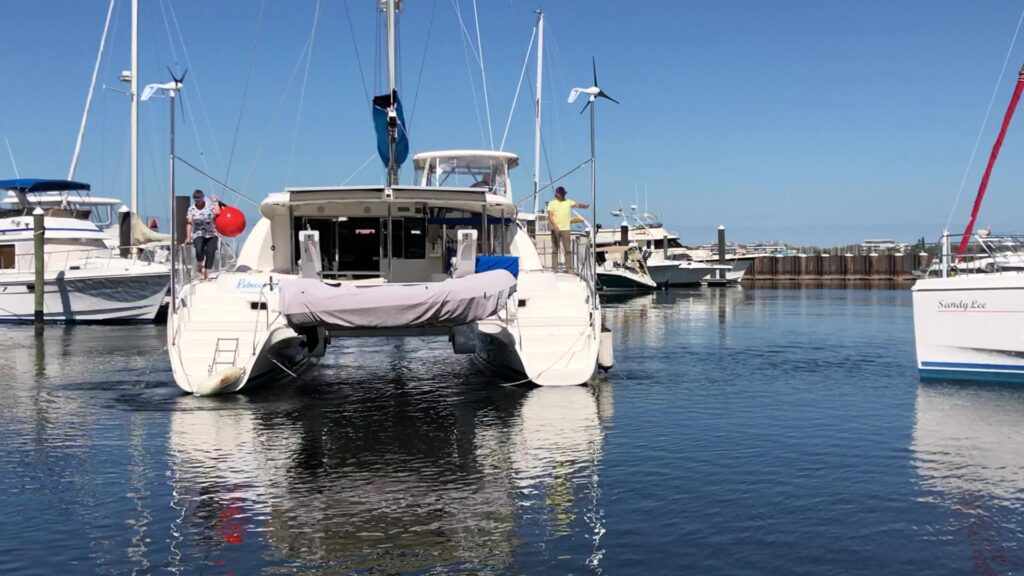
Two owners, one boat, a tight slip, and nobody yelling. The plan gets made before the approach, the roles stick, and the dock stays quiet.
Your marina neighbors will just have to find another show.
How the week can help you go without the hired captain
Insurers generally want to know that the people at the helm can handle this boat. The week is built around exactly that: documented, on-your-boat training in close-quarters handling, docking, systems, and crew roles. At the end you get a YachtTrain sign-off on this hull that you can hand to your insurer.
If your carrier accepts the training and the documentation, that sign-off can help clear or shorten the captain-on-board condition. It isn't a guaranteed waiver. Carriers differ, and the decision is theirs. We'd rather say so now than on Day 6.
What the week can help you walk away with:
- Reps on your own boat, in your own slip, not on a boat you'll never see again
- Both owners able to steer, dock, and run the systems
- A YachtTrain sign-off for your insurer to review (it's not a USCG license)
- A calmer first weekend without anyone else aboard
A captain year is a perfectly good option. It's just a long time to be a passenger on your own boat.
So… who's at the helm?
Just closed, or about to? Text us with the boat, the marina, and the week you have in mind, or call if that’s easier. There's no script, just a conversation. Being nervous tells you something useful. It isn't a personal failing.
YachtTrain, presented by Premium Captains · South Florida, Virginia Beach / Hampton Roads, VA, or we come to the boat.